
At a glance
- Overdrafts and other variable debt reprice when the cash rate moves. List your facilities, mark which are fixed and note when each one is due for review.
- Rising rates can reduce your borrowing capacity, while slower customer payments may affect the bank statements lenders assess. Consider arranging funding while your account still looks healthy.
- Decide whether to buy now or wait based on what the purchase could earn, then compare current lender offers using the total amount repayable.
After three years of falling rates, money is getting more expensive again. The Reserve Bank lifted the official cash rate (OCR) in July and raised it a second time in September. The Committee has said it may need to increase the OCR further this year, with the next review on 28 October.
Any overdraft, credit card or variable term loan you hold has already repriced, approval takes more evidence than it did, and customers may be taking longer to pay you. You can’t change the cash rate, but you can change what you do about the facilities you hold and how you approach your next borrowing decision.
Only some of your facilities move when the cash rate does
Lenders borrow before they lend. When the official cash rate rises, borrowing costs them more, and what you’re charged follows. Variable-rate facilities, including plenty of equipment finance, reprice when the cash rate moves. A fixed-rate loan holds the repayment you agreed for the length of the term, so a rise after settlement doesn’t reach it.
If you fixed while rates were falling, you’re holding a rate you won’t be offered today. If you didn’t, you may have already absorbed two increases.
To know where you’re exposed:
- Write down every facility your business holds and mark each one fixed or variable.
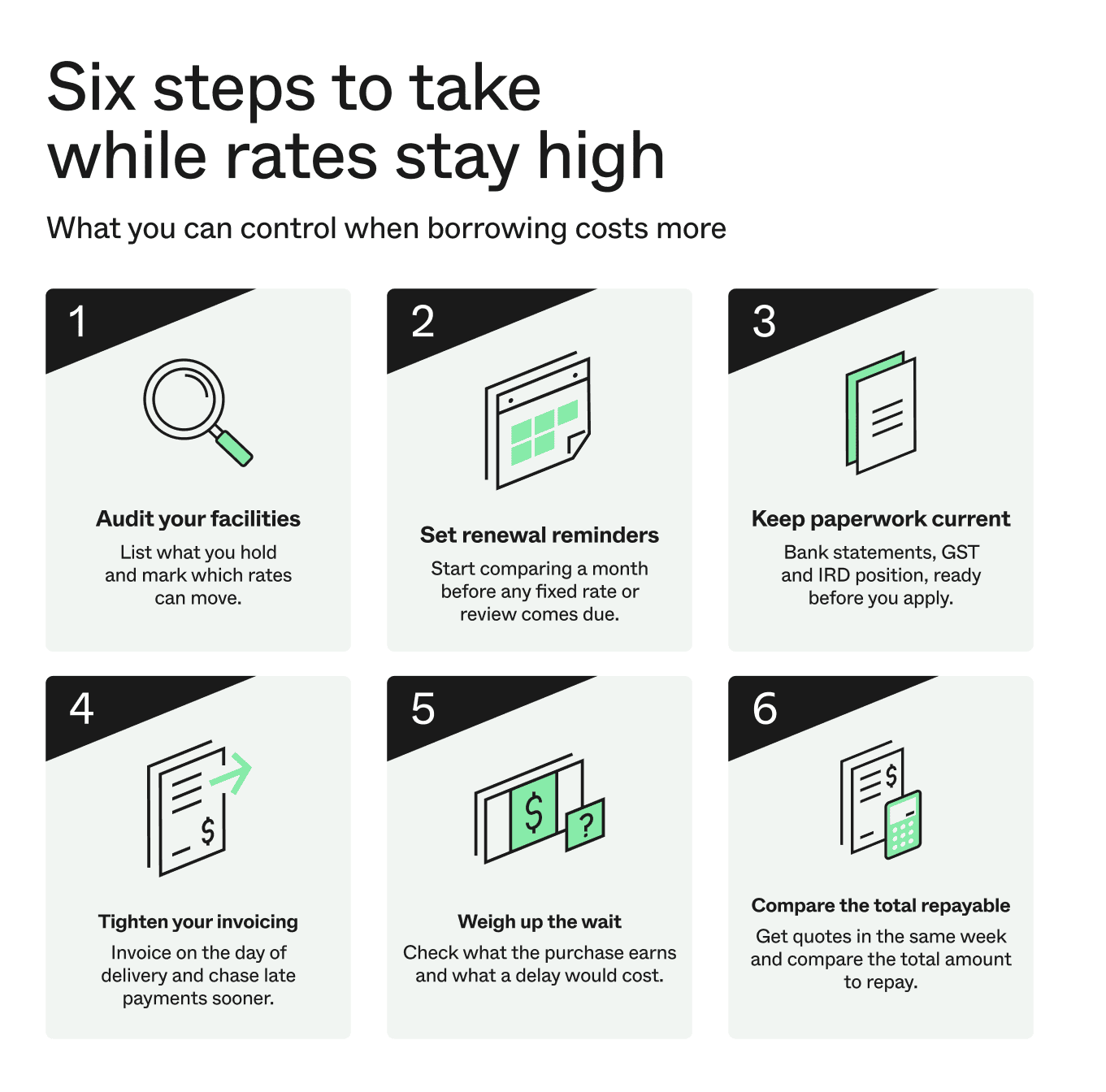
- Note when each one expires or comes up for review. A fixed rate ending soon gets rewritten at whatever the market is charging then, so set a reminder a month out and start comparing before it rolls over.
- Rank them by what they cost you. An overdraft reprices with every rate move, so it can quietly become the most expensive facility you hold.
- Pay off the top one first, since it’s costing you the most.
If it turns out to be an overdraft, look at what could replace it before you pay it down.
Rising rates reduce your borrowing capacity
When you apply, lenders add a buffer to the rate they quote you and check whether your business could still afford the repayments at that higher level. When the cash rate rises, the level they test you against rises with it, so the same business qualifies for a smaller loan.
The buffer is there because a lender wants to know you’d keep up with the repayments if rates keep climbing. As the gap between what you earn and those tested repayments narrows, every figure in your application carries more weight. Expect to be asked for more months of bank statements, a current GST and IRD position, and an explanation for any month that looks unusual. Depending on the lender and the amount, you may also be asked for security. Our eligibility guide covers what gets assessed and what to have ready.
If you worked out your borrowing capacity before the rises started, the number is likely lower now, even though your trading hasn’t changed. For a current picture, bring your paperwork up to date and weigh up lenders, since what they look for varies as much as the rates they offer. Comparing their offers is covered below.
Customers pay you more slowly when rates rise
Your customers are paying more to borrow too, so they hold on to cash longer, including the money they owe you. Invoice payments start arriving weeks late, larger customers stretch their own payables to protect their position, and the businesses further down the chain absorb it. Discretionary spending gets pushed back, so orders come in smaller and later.
To take control of what you can, invoice on the day of delivery and chase late payments sooner. That pulls money in without asking for credit.
If you need funding, you may want to start arranging it before it gets harder to secure. Lenders read your bank statements, so an application made while your account still looks healthy can be perceived as stronger than one made after late payments start to show.
Moving early and waiting both carry a cost
Say you have a quote for a second van, a new oven or a shop fit-out. A rising cash rate adds a question to the decision: commit now, or hold off and see what happens?
Nobody can tell you where rates will end up, but three questions can help you decide:
- Does the purchase earn more than it costs to fund? If the second van adds jobs you’re currently turning away, run the extra margin against the repayment. Our loan calculator gives you that figure in about a minute.
- Is the price of what you’re buying moving? Equipment, stock and fit-out costs don’t wait for the cash rate. If the price rises while you wait, any saving from a lower rate gets absorbed by the higher purchase price, and if rates keep climbing, you pay more on both.
- What does the delay cost you? Jobs you can’t take, capacity you don’t add and customers who go elsewhere are real costs, even though none of them appear on an invoice. Put a number on them before you decide.
Work through all three and you’ll know whether committing now or holding off makes more sense for your business. What you want to avoid is rushing to lock in a rate when you don’t need to, or deferring until you’re borrowing under pressure on terms you had no time to compare.
A facility’s length matters as much as its rate
When rates rise, every extra month you carry a balance costs more, so borrowing for longer than you need gets expensive.
Covering the six weeks between paying a supplier and getting paid by a customer needs different funding from buying equipment you’ll use for years. Use a five-year loan for the short gap and you’re still paying interest long after it has closed. Put the equipment on a short facility and the weekly repayment eats the cash flow it was meant to free up.
The solution is matching the funding to the length of the job. A business line of credit can suit gaps that keep recurring, since you only pay interest on what you draw, plus a weekly service fee on your facility limit. A small business loan can suit a one-off purchase with a known cost, where a lump sum and a fixed interest rate let you plan the next few years around a repayment that doesn’t move.
Comparing offers gets harder when rates are moving
Two offers land a fortnight apart and the rates look close. One may have been priced before the latest rate change and the other after it, so the rates on the page might not be measuring the same thing.
Start by lining the offers up. Ask for quotes in the same week, and check how long each one stays valid. Then ask every lender for the total amount repayable over the life of the facility. That figure takes in the establishment and ongoing fees and the length of the loan, so if the quotes are current, you can use it to compare apples with apples. After that, look at the terms that affect your cash flow: whether repayments come out weekly or monthly, what happens if you pay it out early, and whether security is required.
Lenders also differ in how fast they move, which counts when a stock order has a deadline. Same-day funding is realistic with some lenders and not with others, and you can compare business loans side by side before you talk to anyone.

No two businesses are weighing the same decision
There’s no single right answer here. If your loan is fixed with years left on the term, you have time to plan, while an overdraft coming up for review next month needs a decision now. Either way, knowing what you’d qualify for before you need funding costs nothing.
If you want to understand your options while there’s no pressure on, talk to a Prospa lending specialist.