

Don’t let a quiet period put you under pressure. Discover practical ways to cut costs, cover essential bills, and use financial tools to keep your business moving.
At a glance
- Plan for quiet periods by laying out essential expenses, cutting unneeded costs, and managing business cash flow proactively.
- Use financial tools to forecast gaps, stay on top of payments, and maintain visibility when turnover slows.
- When cash reserves are low, a short-term business loan can help you bridge shortfalls and cover the essentials.
When business slows down, uncertainty can build quickly. You still have wages to pay, rent, and suppliers to cover, but income isn’t covering it. That pressure can shake the confidence of even the most organised owner.
You might be asking yourself: How long will my cash reserves last? Which costs do I prioritise? And what happens if the quiet patch goes on longer than planned?
Preparing early makes all the difference. This guide provides clear steps to prioritize your tasks, manage your expenses, and navigate slower periods without losing momentum.
Why managing costs during quiet times matters
When business slows down, your fixed costs still keep coming. Rent, utilities, insurance, and loan repayments continue to roll in. Without steady income to cover them, they can put pressure on your cash reserves.
This is why managing costs during quiet periods is critical. It keeps you in control, and gives your business room to breathe, so you don’t need to resort to tough decisions later, like cutting staff or selling equipment. This way you can regain pace faster when business picks up again.
How to separate the essentials from the rest
No one wants to make difficult financial decisions when they are already under pressure. Reviewing expenses only after turnover slides puts you on the back foot, leading to choices that do more harm than good.
Doing the groundwork early makes the choices clearer later. Start by separating the non-negotiables that you have to cover to keep the lights on from the “nice-to-haves” that you can safely put on hold. This way, if turnover slows, you’re not scrambling for answers; you already have a solution in place.
Essential expenses
Essential expenses are your non-negotiables – the costs you must cover to keep your business operating day to day. These should be protected first, even during slower periods.
The list includes:
- Rent or mortgage payments
- Payroll and KiwiSaver
- Utilities (electricity, water, internet)
- Key suppliers (the ones who provide what you need to make or sell your core product)
- Insurance
- Loan repayments
These payments are your priorities. Missing them can strain or permanently damage relationships with staff and suppliers. Even worse, it could grind your operations to a halt.
Non-essential expenses
Non-essential expenses usually support growth, comfort, or team culture. They still matter, but you can pause them for a period without affecting your core operations.
This list includes:
- Staff bonuses or travel
- Entertainment and subscriptions (magazines, apps, and online services)
- Non-critical software (that tool you only use once a month)
- Office upgrades, new furniture, or equipment that isn’t broken
- Some marketing budgets (the campaigns that focus on long-term brand building rather than immediate sales)
Cutting or pausing these costs can ease the pressure on cash flow and give you more room to work through a quieter period.
Comparing essential and non-essential expenses
| Feature | Essential Expenses | Non-Essential Expenses |
|---|---|---|
| Purpose | Keeps your business operational | Supports comfort, growth, or morale |
| Examples | Payroll & KiwiSaver, rent/mortgage, utilities, key supplier invoices, insurance, and loan repayments | Staff bonuses, travel, entertainment, non-critical software/subscriptions, office upgrades, and some marketing |
| Impacted If Reduced | High: May halt operations, create legal/team issues, or damage supplier trust | Low: Operations continue with minimal impact |
| Action During Downtime | Prioritise payment to maintain stability and trust | Reduce, defer, or pause to ease pressure on cash flow |
Practical steps to lower costs
When business slows, the smartest move is to take control early. Here’s how you can lower costs without sacrificing quality or momentum:
Step 1. Review subscriptions line-by-line. Go through your bank statements and list every recurring subscription, membership, and software tool. Ask yourself, “Is this making money right now?” Pause or cancel anything that isn’t adding real value during quieter periods.
Step 2. Talk to your suppliers (and landlord). Reach out before invoices are due. Discuss extended payment terms or whether early-payment discounts are available. The same applies to your landlord – during a well-communicated quiet patch, you may be able to arrange temporary rent relief or revised timing.
Step 3. Align your staffing with demand. Look closely at your quietest days or hours. Can you adjust rosters to better match reduced demand? This isn’t about cutting team members, but about aligning labour costs with the level of work coming in.
Step 4. Cut waste from your operational overheads. Review your utility and service plans rather than letting them renew automatically. Check whether you’re on the best rate for electricity, internet, or phone services. Look at your stock levels too – holding excess inventory ties up cash unnecessarily. Ordering less, more often, can help protect your cash flow.
Step 5. Automate how you collect payments. Time is money, especially when you’re chasing invoices. Use your accounting software to send automated invoice reminders. Faster payment cycles reduce cash-flow strain, all without cutting a single expense.
Using financial tools to stay ahead of cash-flow gaps
Once you’ve reduced your costs, the next step is gaining clear visibility over your cash flow. Financial tools you already use, like your accounting software, or a resource such as Prospa’s free cash flow forecasting template, can help you plan ahead, test different scenarios, and identify a shortfall before it occurs.
If your forecast shows a gap, you can look at finance options that help bridge it. A Prospa Small Business Loan, for example, is designed to support business cash flow. It can help you cover essential costs like payroll, rent, or supplier payments, giving your business the breathing room it needs while things are quieter, along with the momentum to recover when business picks up.
| Case Study |
|---|
 When Sam Corcoran and TJ Smith of Corcoran Smith Financial hit a quiet patch, they needed flexible funding to manage cash flow and keep their commission-based business steady. Instead of turning to traditional lenders, they chose a Prospa Business Line of Credit to maintain stability during slower months and support the launch of their second venture. “Prospa made it easy to access the cash flow we needed, right when we needed it. The process was fast and efficient, and it gave us real peace of mind during quieter periods.” – Sam Corcoran, Corcoran Smith Financial. |
Quick wins to protect your cash flow
Once you’ve taken the steps above, here are three fast, practical actions you can put in place today to protect your cash and stay in control.
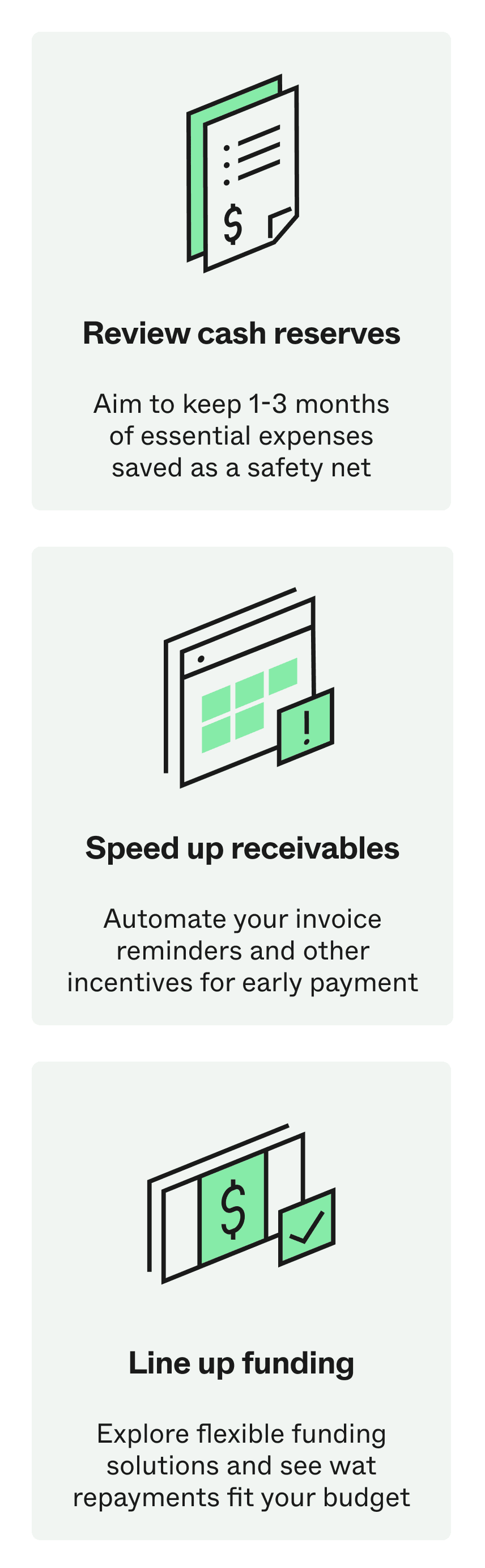
- Review your cash reserves. Know exactly how much you have available for emergencies. One to three months of essential expenses set aside gives your business room to move when things are quiet. This is your safety net.
- Speed up your receivables. Don’t wait for customers to pay you. Offer small incentives to encourage early payment. More importantly, automate invoice reminders, so you aren’t chasing overdue payments.
- Line up a funding solution. If your forecast shows a cashflow gap, don’t wait until you’re in it to explore funding options. A Prospa Small Business Loan or Business Line of Credit can give you flexibility when things are quiet. You can use the Prospa Business Loan Calculator to check what repayments may fit your budget before you apply. With funding ready to go, you can bridge short-term gaps quickly and avoid unnecessary pressure.
Quick wins to protect your cash flow

Having a plan keeps you in control
Every business experiences busy periods and quiet ones. The resilient ones are those who prepare for these cycles, spotting potential gaps early, and acting before pressure builds. By identifying your essential costs, reducing non-essential spending, and using the right financial tools and products, you can manage slow periods with more confidence and control.
If you need support to cover a short-term gap or want to be ready for the next opportunity, talk to one of our specialists today.